
Online Geometry Course for Grades 8 and 9: Proofs, Triangles, Circles and Trigonometry
Geometry is for students in grade 8 or 9 who have completed Algebra 1, before Algebra 2. It covers proofs, triangles, similarity, trigonometry, circles, and area, surface area and volume.
- Grade 8 or 9
- Live, once a week, 2 hours
- Up to 8 students
- 3 levels, set by a free assessment
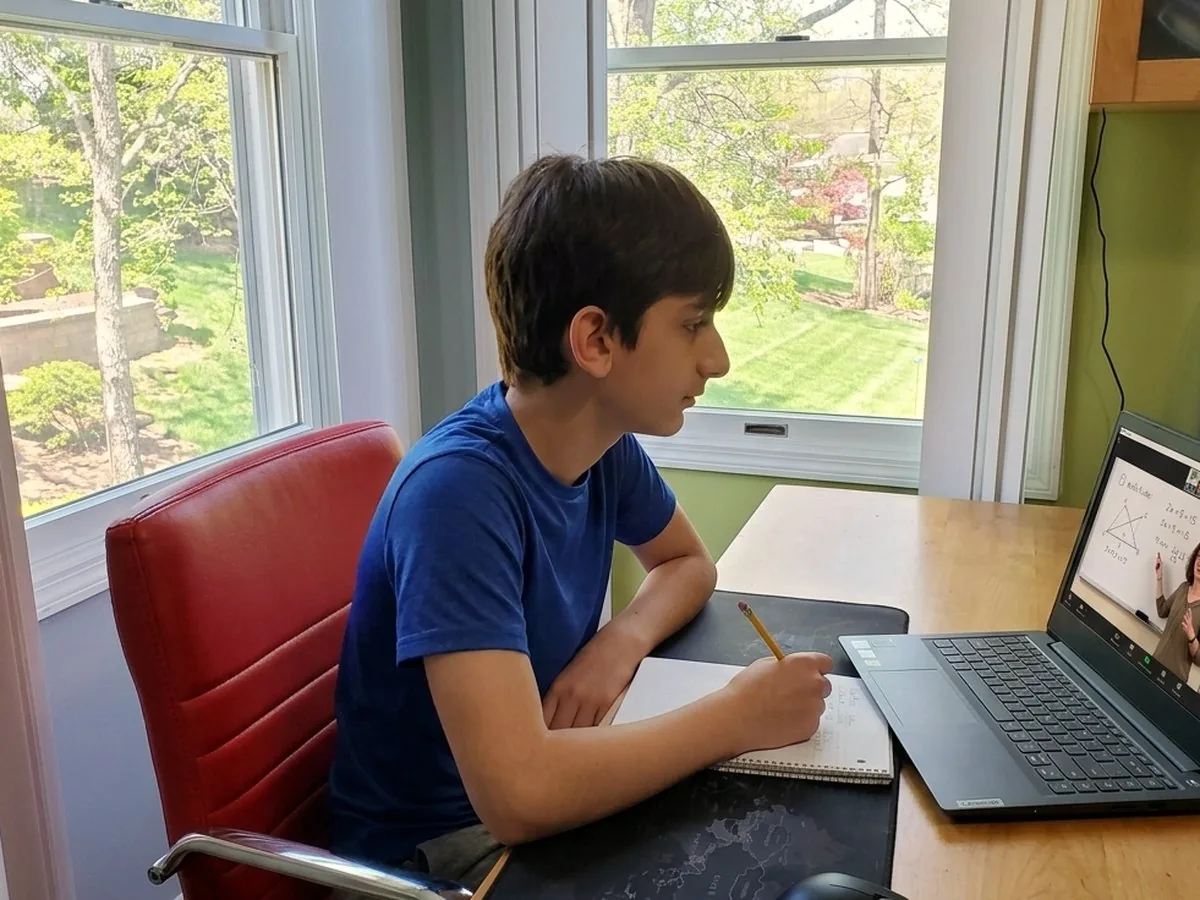
What Geometry at Avatar Covers
Geometry works from points, lines and angles through proofs, triangles, similarity, trigonometry, quadrilaterals, transformations and circles to area, surface area and volume.
Every week combines definitions, postulates and theorems with worked examples, practice, an interactive activity and challenge problems, and the last week is a mixed review. Students write two-column proofs from the second unit on.
What Students Can Do After Geometry
Two-column proofs
Write two-column proofs using definitions, postulates and theorems.
Congruence and similarity
Prove triangles congruent or similar and use the results to find lengths and angles.
Right triangles and trigonometry
Solve right and general triangles with the Pythagorean Theorem, trig ratios and the Laws of Sines and Cosines.
Quadrilaterals and circles
Use properties of quadrilaterals and circles, including chords, tangents and inscribed angles.
Transformations and coordinates
Apply transformations and write equations of lines and circles in the coordinate plane.
Area, surface area and volume
Find area, surface area and volume of plane figures and solids.
The Syllabus, Unit by Unit
Open a unit to see its topics. All three levels follow the same units; the pace, depth and amount of practice differ. Every week has a live class and a homework set checked in the student portal.
Unit 1Segments, Angles and Polygons3 topics
Points, lines and planes, segment and angle measure with the Midpoint and Distance Formulas, constructions, angle pairs, polygons, and perimeter and area.
- Elements of Geometry and Segment AdditionUndefined terms (point, line, plane), postulates, rays and opposite rays, collinear and coplanar points; then distance and length, the Segment Addition Postulate, congruent segments, midpoints and segment bisectors.
- Distance, Midpoint, Angles and Angle AdditionThe Midpoint Formula and Distance Formula in the coordinate plane, a construction of a segment's midpoint, then naming, measuring and classifying angles, congruent angles, the Angle Addition Postulate and angle bisectors.
- Angle Pairs and PolygonsAdjacent angles, linear pairs, vertical angles, complementary and supplementary angles; then polygons (convex or concave, equilateral, equiangular, regular), the angle sum of a polygon, and perimeter and area of basic shapes.
Unit 2Proofs, Parallel Lines and Slope3 topics
Properties of equality and two-column proofs, angles formed by a transversal and the converses that prove lines parallel, then slope and the equations of lines.
- Proofs by Reasoning and CongruencyProperties of Equality (reflexive, symmetric, transitive) and the Distributive Property used as reasons in proofs, then the theorems on congruent segments and angles, right angles, congruent supplements and congruent complements.
- Transversals and Angle RelationshipsParallel, skew and perpendicular lines and parallel planes, transversals and the angle pairs they form, the Corresponding Angles Postulate and the theorems for two parallel lines cut by a transversal.
- Angle Converses and Equations of LinesConverses of the angle theorems for proving lines parallel; then slope, slopes of parallel and perpendicular lines, and slope-intercept, point-slope and standard form of a line, with algebra applications.
Unit 3Triangles5 topics
Triangle classification and angle sums, congruence (SSS, SAS, HL, ASA, AAS) and CPCTC, isosceles triangles, bisectors and the triangle centers, midsegments, the Pythagorean Theorem and the triangle inequalities.
- Triangles and CongruencyClassifying triangles by sides and by angles, the Triangle Sum Theorem and Exterior Angle Theorem; then congruent figures, corresponding parts, congruence statements, the Third Angles Theorem and properties of congruent triangles.
- CPCTC and Isosceles TrianglesUsing CPCTC after proving triangles congruent, in two-column proofs, coordinate proofs and real-world problems; then the parts of an isosceles triangle, the Base Angles Theorem, its converse and the corollaries.
- Angle and Perpendicular BisectorsEquidistant points and locus, the Perpendicular Bisector Theorem and the Angle Bisector Theorem with their converses, then concurrent lines, the circumcenter and incenter of a triangle and its circumscribed and inscribed circles.
- Median, Altitude, Centroid, Orthocenter, IncenterMedians and the centroid, altitudes and the orthocenter, a recap of the special segments and centers of a triangle, the median to the hypotenuse, and mixed problems on the circumcenter and incenter.
- Midsegment, Pythagorean Theorem, Triangle InequalitiesThe midsegment of a triangle and the Midsegment Theorem; the Pythagorean Theorem with a proof, Pythagorean triples and its converse; and the two triangle inequality theorems relating sides to opposite angles.
Unit 4Similarity2 topics
Ratios, proportions and scale, similar polygons, the AA, SSS and SAS similarity tests, proportionality theorems, and a review week.
- Ratios, Proportions, Similar PolygonsRatios, proportions and the Cross Product Property, scale drawings, then similar polygons: scale factor, similarity ratio, identifying similar polygons and similar triangles formed by parallel sides.
- Triangle Similarity, ProportionalityThe Perimeter Theorem for similar polygons, the AA Similarity Postulate, the Triangle Proportionality Theorem and its converse, three parallel lines, the angle bisector proportion, and SSS and SAS similarity. A challenge covers the golden ratio.
Unit 5Right Triangles and Trigonometry3 topics
Special right triangles, polygon angle sums, the tangent ratio, sine and cosine, geometric mean, inverse trig, and the Law of Sines and Law of Cosines.
- Angles in Polygons and Tangent RatioPolygon definitions, the interior-angle sum (n − 2)·180°, one angle of a regular polygon and the exterior-angle sum of 360°; then the tangent ratio, angles of elevation and depression, and tan⁻¹ to find an angle.
- Trigonometric Ratios and Geometric MeanNaming the sides of a right triangle, sine, cosine and tangent (SOH-CAH-TOA) for sides, trig values, slope and area, and inverse trig for angles; then the geometric mean with the Altitude and Leg Theorems.
- Law of Sines and CosinesA recap of right-triangle trig and inverse trig, then the Law of Sines and Law of Cosines for any triangle, choosing between them, classifying a triangle by its sides, and the identity sin²α + cos²α = 1 with special-angle values.
Unit 6Quadrilaterals and Transformations4 topics
Parallelograms, rhombuses, rectangles, squares, trapezoids and kites with their theorems and area formulas, then translations, reflections, rotations and dilations.
- Quadrilaterals (Parallelograms)Quadrilaterals and parallelograms: opposite sides and angles congruent, consecutive angles supplementary, diagonals bisecting each other; then five ways to prove a quadrilateral is a parallelogram, with algebra and coordinates.
- Special ParallelogramsRhombus, rectangle and square: their defining properties and theorems, a Venn diagram of the parallelogram family, the diagonal theorems, and classifying a quadrilateral. Includes a review of polygon angle sums.
- Trapezoids and KitesTrapezoids (bases, legs, base angles, isosceles trapezoids, the midsegment theorem) and kites; classifying all the special quadrilaterals; and deriving area formulas for the parallelogram, rhombus and trapezoid.
- TransformationsTranslations, reflections, rotations and dilations with their coordinate rules, identifying a transformation from a preimage and image, and real-world uses. The week closes with a review of the Law of Sines and Law of Cosines.
Unit 7Circles4 topics
Parts of a circle, arcs and circumference, tangents, inscribed angles, angles and segments formed by chords, secants and tangents, and the equation of a circle.
- CirclesParts of a circle, circumference C = πd = 2πr, tangents and secants with the Tangent Line Theorem, central angles and arcs (minor, major, semicircle), arc length, and congruent circles and arcs.
- Circles with Other Geometric FiguresInscribed angles and their intercepted arcs, inscribed polygons and quadrilaterals, tangent-chord angles, angles formed inside and outside a circle, and concentric and inscribed circles with tangent lengths.
- Circles and PropertiesThe Segments of Chords, Segments of Secants, and Segments of a Secant and a Tangent theorems, with proofs and vocabulary, followed by mixed problems on arcs, angles, chords and tangent-radius right triangles.
- Equation of a CircleThe equation of a circle centered at the origin, x² + y² = r², and the standard form (x − h)² + (y − k)² = r²; writing it from a graph, a diameter or a point, completing the square, and tangent and secant lines.
Unit 8Area, Solids5 topics
Areas of polygons and circles, sectors, surface area and volume of solids, three-dimensional coordinates, and a mixed review of the whole course.
- Areas of PolygonsAreas of squares, rectangles, triangles and parallelograms, then trapezoids, rhombuses and kites, areas from coordinates, perimeters and areas of similar polygons, and a summary of the area formulas.
- Areas and Circumference of Circles and PolygonsCircumference and area of a circle, arc length and the area of a sector, shaded regions and composite figures, and the area of a regular polygon using its apothem and central angle.
- Polyhedra, Nets, Surface AreaPolyhedra, prisms and the regular (Platonic) solids, cross sections and nets, then surface area of prisms, pyramids, cylinders, cones and spheres. A challenge covers Euler's formula.
- Volume of Basic SolidsVolume of prisms, cylinders, pyramids, cones and spheres, oblique solids and Cavalieri's Principle, truncated cones, volumes of similar solids (ratio a³ : b³), and Euler's formula.
- Geometry in SpaceOrdered triples, the Distance and Midpoint Formulas in space, solids cut by a plane parallel to the base, and surface area and volume of composite solids such as a castle, an hourglass and a capsule tank.
Which Geometry Class Is Right for Your Child?
All three levels follow the same units, so a student can move between them during the year. The difference is pace, depth and how much practice each topic gets.
Catching up
For students who arrive with gaps. Core skills get more time and more practice before the harder topics.
Building skills
For students doing fine in school who want stronger grades and real understanding. The full syllabus at a steady pace.
Advanced
For students ready for a challenge: harder problems, more reasoning about why the methods work, and extra topics.
Placement first
The free assessment places your child. Teachers watch the weekly results and recommend a move up when a child is ready.
Questions Parents Ask About Geometry
What grade is Geometry for?
Most Avatar students take Geometry in grade 8 or 9, after Algebra 1. The placement assessment confirms readiness. Algebra 2 is the next course.
What does my child need before starting?
Algebra 1, especially solving equations and working with square roots. The course teaches proofs from the ground up.
How does Geometry relate to what my child learns in school?
Avatar teaches its own curriculum, generally aligned with what schools cover in Geometry, so it supports schoolwork. It goes further than the school course, with more problem solving and more practice.
How much homework is there?
One homework set a week, done in the student portal. Each answer is checked as soon as it is submitted, and a wrong answer can be tried again. A student who is stuck can raise a hand, which tells the teacher which problem to go over in the next class. Plan on about 60 to 90 minutes for each set.
How do I follow progress?
The parent portal shows attendance, each week's homework and quiz scores, time spent on the work, and progress over the year, updated in real time.
When does the course start, and can my child join later?
The 34-week year runs from September to June. A student can join during the year after a placement assessment, and the teacher helps them catch up on the weeks they missed.
Founded and Taught by Scientists
Four women scientists with PhDs founded Avatar in 2020 and still teach. Most of our instructors hold a PhD or a master’s degree and have worked as scientists or engineers. Meet the whole teaching team
 Dr. Armine ArustamyanCo-founder · PhD · Business Administration, Physics
 Dr. Astrid BabayanCo-founder · PhD · Industrial Engineering and Operations Research
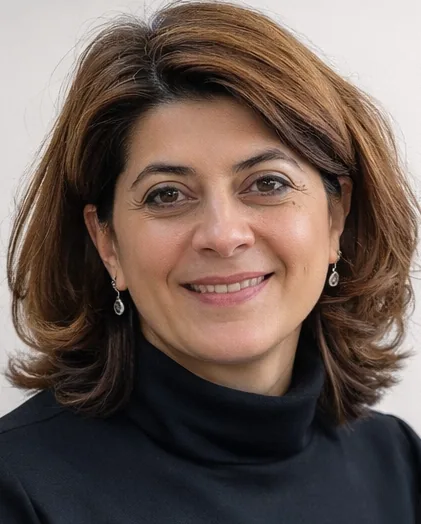 Dr. Margarit KhachatryanCo-founder · PhD · Industrial Engineering
 Dr. Lana YeganovaCo-founder · PhD · Operations Research, scientist at the NIH
What Parents and Students Say
Successful Placement!
“Avatar Math has provided me with great success, one of them being the school's placement testing NWEA. Without Avatar I wouldn't have gotten the score I got.”
Aidan8th Grade Student · Google reviewHighly Recommended!
“My son completed the Avatar Algebra I program. The program helped my son to obtain an A+ grade at school. It is a great program with very talented teachers. I would highly recommend this school to anyone.”
Anna AvetisyanParent · Google reviewOutstanding Results!
“AvatarMath has provided my daughter with devoted instructors. She has overcome her fear for math and developed a strong foundation, improved her grades, and continues achieving outstanding results.”
Nancye TumanoffParent · Google reviewChallenged and Encouraged!
“Both of our children—one in 7th grade and one in 2nd grade—are enrolled at AvatarMath, and we couldn’t be happier. It’s wonderful to have a place where both of our kids are challenged and encouraged to love learning math.”
Marina BalasanovaParent of two · Google reviewEngaging and Effective!
“My daughter has had an incredible experience with online math program with AvatarMath. The classes are engaging, supportive, and highly effective in boosting her confidence and understanding of math concepts. We've seen significant improvement in both the grades and attitude toward math. Highly recommend!”
Stepan TerzyanParent · Google reviewAttitude Turned Around!
“Like most kids, our son had a negative attitude toward math. Thanks to Avatar, his academic performance has greatly improved. We highly recommend them!”
John HazakisParent · Google reviewOur Third Year!
“Next year will be our 3rd year with Avatar. We are so grateful for their dedicated teachers and great program. My 3nd grader developed passion for math for which we are very thankful!”
Lily MovsisParent · Google reviewFast Progress!
“My son Nicholas studied at the Avatar Math Summer program last year. The program is advances, he learn fast, which was beneficial for the entire next school year. Now he is accepted to advance learning program for talented kids in his school. The teachers ware caring, patient and supportive. Thank you for helping Nicholas to progress in math so fast!”
Elena DetwilerParent · Google reviewProfessional Teachers!
“Avatar tutoring is a team of professional teachers, kids and teens friendly who explain the material in a way understandable for kids and teens. been with Avatar tutoring for more than two years!! love it!! most of all Love the results it gives and the grades received!”
Eric SlobodkinParent · Google reviewEpic Class!
“My son says "Epic good, epic class." My son really enjoyed the program and he learned core math fundamentals. He plans to continue.”
Sean McClureParent · Google reviewComprehensive Program!
“The Avatar math program is very comprehensive and the technology is top-notch for the homework and lessons completion. My kid enjoyed the warm, patient and fun environment of the in person class and the kindness of Ms. Tatiana and Ms. Lana. It helped him practice more and move to the above grade math class at school. We look forward to participating in more in person classes in the future. Thank you Avatar Math!”
VitoParent · Google reviewKind and Supportive!
“Math is really fun because it pushes me to think outside of the box and adds creativity to my thinking. Teachers in Avatar are very kind and supportive.”
Lana7th Grade Student · Google reviewTop-Notch!
“Avatar is simply outstanding! The teachers are exceptional, and the quality of education is top-notch. Highly recommended!”
Florentin GavrilaParent · Google reviewIs Your Child Ready for Geometry?
Book a free placement assessment. We check the foundations and recommend the level that fits.